Mixed Developments
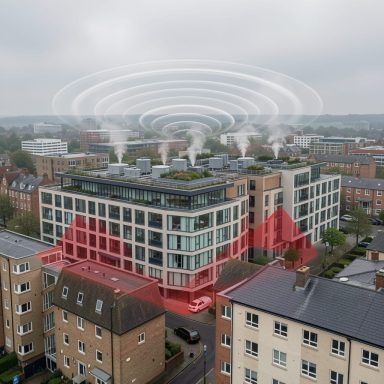
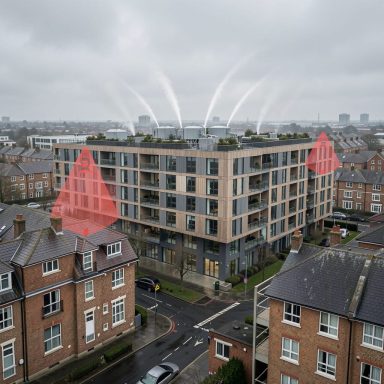
Odour and noise assessments are particularly critical for mixed-use developments, where residential, commercial, and industrial activities coexist in close proximity. Early evaluation helps identify potential conflicts between sensitive receptors and operational sources, ensuring that design solutions balance amenity with functionality. Through baseline monitoring, predictive modelling, and integrated mitigation strategies, consultants can support planning approval, protect occupant wellbeing, and enable sustainable development that successfully accommodates diverse land uses.
Odour & Noise Assessments for Mixed-Use Developments
Mixed-use developments are now a central feature of UK urban planning. Schemes combining residential, commercial, leisure, and retail uses create vibrant environments — but they also introduce complex environmental challenges.
For many projects, a noise impact assessment and odour impact assessment are critical components of a mixed-use planning application. When residential units sit above commercial premises or adjacent to operational plant, environmental risk must be carefully managed.
Understanding how odour and noise assessments apply to mixed-use developments can reduce planning delays and improve scheme viability.
Why Mixed-Use Developments Create Environmental Complexity
Unlike single-use schemes, mixed-use developments bring together noise-sensitive receptors and noise or odour-generating activities within the same site boundary.
Common examples include:
- Residential apartments above restaurants
- Commercial kitchens within ground-floor retail
- Rooftop plant serving retail or leisure units
- Servicing yards adjacent to residential courtyards
- Gyms or entertainment venues below housing
In these situations, a mixed-use development noise impact assessment must consider both external and internal noise transmission. Similarly, an odour assessment for mixed-use planning must account for vertical and horizontal dispersion within close proximity.
The environmental interaction is more complex than in standalone commercial or residential schemes.
Noise Impact Assessment for Mixed-Use Planning Applications
A noise impact assessment UK for a mixed-use development typically addresses two key questions:
- Will plant and commercial activity impact nearby existing residential receptors?
- Will proposed residential units experience unacceptable noise from commercial uses within the same scheme?
This dual assessment requirement often increases modelling complexity.
In mixed-use developments, noise sources may include:
- Mechanical ventilation and air conditioning plant
- Kitchen extraction systems
- Refrigeration equipment
- Delivery and servicing activity
- Music or amplified sound from leisure uses
A planning application noise assessment must evaluate the cumulative impact from all operational sources. Where residential units are integrated into the development, façade performance and building fabric design may also be relevant.
Acoustic modelling is often required to predict plant noise at sensitive façades and assess compliance with local authority expectations.
Odour Impact Assessment in Mixed-Use Schemes
Odour is a frequent issue in mixed-use planning applications, particularly where food and beverage uses are proposed at ground floor.
An odour impact assessment UK for a mixed-use development typically evaluates:
- Extraction system design
- Stack height and discharge velocity
- Proximity of residential windows and balconies
- Prevailing wind conditions
- Cumulative odour sources within the area
Where residential accommodation is directly above a commercial kitchen, odour dispersion modelling may be required to demonstrate that amenity will not be compromised.
Early odour assessment for mixed-use planning ensures that abatement systems, carbon filtration, or electrostatic precipitation systems are correctly specified before submission. The success of a mixed-use development depends on compatibility between uses. Noise and odour assessments are tools to ensure that commercial viability does not undermine residential amenity.
Practical strategies often include:
- Strategic placement of plant away from residential façades
- Dedicated service risers for kitchen extraction
- Enhanced façade glazing performance
- Acoustic enclosures integrated into rooftop design
- Carefully positioned discharge stacks to maximise dispersion
When these measures are considered early, they strengthen the planning application and reduce future complaint risk.