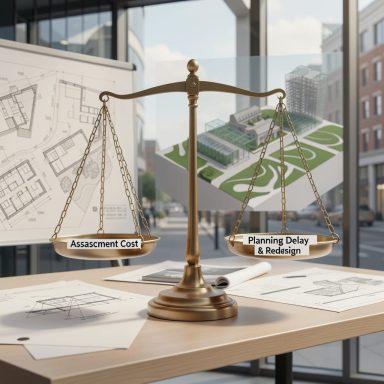
Environmental Assessment Costs
Understanding environmental assessment costs at the outset of a project is essential for effective budgeting and risk management. Costs can vary significantly depending on project scale, site sensitivity, regulatory requirements, and the level of technical analysis required. Early scoping helps define the extent of surveys, modelling, and reporting needed, preventing unexpected expenses and programme delays. By investing in proportionate, well-planned assessments, organisations can reduce long-term financial risk, avoid costly redesigns, and ensure smoother planning and compliance processes.
The Cost of a Noise & Odour Impact Assessment in the UK (2026 Guide)
One of the most common questions asked during the planning process is: How much does a noise impact assessment cost in the UK? Closely followed by: What is the cost of an odour impact assessment for a planning application?
The cost of a noise impact assessment or odour impact assessment in the UK varies depending on site complexity, survey requirements, modelling scope, and mitigation strategy. However, understanding what influences environmental assessment cost can help developers budget accurately and avoid unexpected fees.
What Influences the Cost of a Noise Impact Assessment in the UK?
The cost of a noise impact assessment UK planning application depends on several technical factors.
1. Baseline Noise Monitoring Requirements
Most planning applications require baseline noise surveys. The duration and complexity of monitoring significantly affect cost.
A simple small-scale development with limited plant may require short-term unattended monitoring. Larger or more sensitive sites, particularly mixed-use or residential schemes, may require extended monitoring, multiple survey locations, and attended measurements.
More monitoring increases equipment time, data processing, and reporting scope.
2. Type and Number of Noise Sources
The cost of a noise assessment for planning increases where developments include:
- Multiple items of fixed plant
- Rooftop mechanical equipment
- Commercial kitchen extraction systems
- External loading areas
- Combined industrial and transport sources
Each source may require separate acoustic modelling and cumulative assessment.
3. Acoustic Modelling Complexity
Noise modelling software is typically used where plant noise needs to be predicted at nearby receptors. The number of buildings, screening structures, and receptors will influence modelling time.
A simple plant enclosure assessment will cost significantly less than a multi-block mixed-use development requiring detailed 3D acoustic modelling.
4. Mitigation Design and Iteration
If initial results show exceedances, further modelling iterations may be required to test mitigation such as acoustic barriers or enclosures. Projects requiring multiple mitigation scenarios will typically involve higher consultancy input.
The cost of an odour impact assessment UK planning application is often driven by modelling and emission complexity.
1. Requirement for Odour Dispersion Modelling
Where dispersion modelling is required, the odour assessment cost will increase due to:
- Meteorological data processing
- Emission rate calculation
- Multiple receptor analysis
- Sensitivity testing
Simple qualitative odour assessments are generally lower cost than full dispersion modelling studies.
2. Source Characterisation
Odour impact assessment cost depends heavily on how emissions are defined. If odour emission rates are available from manufacturer data or industry benchmarks, assessment may be straightforward. Where emissions must be estimated or monitored, scope increases.
3. Number of Emission Points
Multiple stacks, vents, or area sources increase modelling complexity and therefore increase odour assessment pricing.
4. Sensitivity of Nearby Receptors
Sites located close to residential properties, schools, or healthcare facilities may require more detailed assessment and justification, increasing reporting scope.
While every project is different, developers often ask for indicative cost ranges.
In the UK, the cost of a noise impact assessment for a small commercial development is typically lower than for large mixed-use or industrial schemes. Similarly, odour impact assessment cost varies significantly depending on whether qualitative assessment or full dispersion modelling is required.
As a broad guide:
- Small-scale plant noise assessment: lower four-figure range
- Larger mixed-use noise modelling studies: mid to upper four-figure range
- Qualitative odour assessment: lower to mid four-figure range
- Full odour dispersion modelling assessment: mid to upper four-figure range
Complex industrial projects may exceed these ranges.